
AI is everywhere and constantly evolving. This year, we’re excited to go beyond the buzzword and highlight practical, evidence-based approaches that enrich teaching and learning, and advance research.
Date & Location Information:
Tuesday, April 7, 2026
9:00 am - 3:00 pm, Doors open at 8:30 am for networking and light breakfast.
Register below.
UMass Boston
Campus Center Ballroom, 3rd Floor
100 Morrissey Boulevard, Boston
Directions & Parking: Maps & Directions - University of Massachusetts Boston
Contact Candyce Carragher ccarragher@umassp.edu with questions.
Agenda
8:30 Networking and light breakfast
9:00 Welcome & Overview of UMass Innovates
Nefertiti Walker, Senior Vice President, Academic Affairs, Student Affairs, & Equity, UMass President's Office
Steve Karam, Chair, University of Massachusetts Board of Trustees
Marty Meehan, President, University of Massachusetts
Marcelo Suárez-Orozco, Chancellor, UMass Boston
Wei Ding, Distinguished Professor, Computer Science, Executive Director of Paul English Applied AI Institute, UMass Boston
9:20 Keynote Speaker

C. Edward Watson, Ph.D., is the Vice President for Digital Innovation at the American Association of Colleges and Universities (AAC&U). He is also the founding director of AAC&U’s Institute on AI, Pedagogy, and the Curriculum. Prior to joining AAC&U, Dr. Watson was the Director of the Center for Teaching and Learning at the University of Georgia (UGA) where he led university efforts associated with faculty development, TA development, learning technologies, and the Scholarship of Teaching and Learning. He continues to serve as a Fellow in the Louise McBee Institute of Higher Education at UGA and recently stepped down after more than a decade as the Executive Editor of the International Journal of Teaching and Learning in Higher Education. 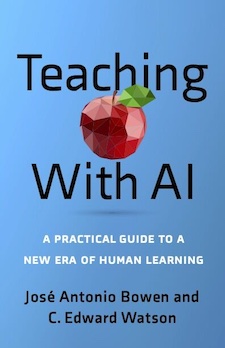 His most recent publications are the second edition of Teaching with AI: A Practical Guide to a New Era of Human Learning (Johns Hopkins University Press, 2025), Leading Through Disruption: Higher Education Executives Assess AI’s Impacts on Teaching and Learning (AAC&U, 2025), and the Student Guide to AI (Elon University & AAC&U, 2025). Dr. Watson been quoted in the New York Times, Chronicle of Higher Education, Inside Higher Ed, Campus Technology, EdSurge, Newsweek, U.S. News, EdTech, Consumer Reports, UK Financial Times, and University Business Magazine and by the AP, CNN and NPR regarding current teaching and learning issues and trends in higher education.
Dr. Watson is the Vice President for Digital Innovation with the American Association of Colleges and Universities (AAC&U) and author of Teaching with AI: A Practical Guide to A New Era of Human Learning.
10:20 Teaching & Learning Lightning Rounds
Kristi Girdharry, Associate Teaching Professor of English & Director of the Writing Center, Babson College
Radically Human Learning in an AI-Saturated World
Anindita Deb, Associate Professor of Neurology and Neurosurgery, UMass Chan Medical School
Training Tomorrow’s Physicians: Integrating Generative AI into Medical Education
Amy Shapiro, Dean, Honors College and Professor of Psychology, UMass Dartmouth
Centering Higher-Order Thinking in AI-Integrated Curricula
Christian Rojas, Professor of Resource Economics, UMass Amherst
Does AI Change How Students Learn? Evidence from an Economics Classroom
11:10 Moderated Student Panel
Join us for a moderated conversation with the AI for the Commonwealth interns — a collaboration between Commonwealth of Massachusetts Executive Office of Technology Services and Security and UMass Amherst. Panelists will share how they partnered with state agencies and faculty and industry mentors to apply cutting-edge AI to real-world challenges facing Massachusetts communities. Hear project highlights and learn how students are using AI in the classroom, in research, and in their everyday lives.
12:00 Lunch
12:30 Research Lightning Rounds
Apurv Soni, Assistant Professor, UMass Chan Medical School
Role of Artificial Intelligence in Digital Health Research
Anna Rumshisky, Associate Professor, UMass Lowell
Building AI That Thinks, Adapts, and Collaborates
Adrian Zai, Associate Professor, UMass Chan Medical School
AI Is Easy. Trust Is Hard. Building the Missing Infrastructure for Responsible Healthcare AI.
Emily Singley, Vice President, Global Library Relations & Partnerships, Elsevier
Redefining Research with LeapSpace: Elsevier’s Next-Gen AI Solution
1:15 Presentation & Demonstration
Mentoring in the Age of AI: Augmenting Human Relationships with Human-at-the-Helm Technology
Jean Rhodes, Professor, UMass Boston and Co-Founder of MentorPRO. Dr. Rhodes is the Frank L. Boyden Professor of Psychology and Director, Center for Evidence-Based Mentoring.
This presentation and demonstration will explore how artificial intelligence can be thoughtfully integrated into mentoring programs to extend their reach without compromising relationship quality. The promise and pitfalls of AI in mentoring contexts, drawing on research and practical lessons from implementing AI-powered tools that support mentors with real-time guidance while keeping human connection at the center will be discussed. Using MentorAI as an example, the session will address how institutions can leverage technology to scale mentoring, identify students who need support, and equip mentors with evidence-based strategies, all while preserving the authenticity that makes mentoring effective.
1:45 Wrap up of the day
Gabriala Weaver, Assistant Vice President & Professor for Academic Affairs and Research, AASAE, UMass President's Office
After the formal program concludes, attendees are invited to participate in one of two optional workshops.
2:00 Workshop 1
AI for Teaching and Learning: A Hands-on Workshop, C. Edward Watson
Designed for those who are interested in employing AI within the context of their curriculum and/or courses, this hands-on workshop will begin by providing participants with a guided, hands-on exploration of key generative AI tools currently being used today. The world of generative AI is not monolithic, as there are a variety of systems and each has different strengths and weaknesses. After briefly detailing this landscape, the workshop will shift to specific applications of AI within teaching and learning settings. A key theme will be how faculty can ensure their students achieve the learning outcomes of their course while also engendering AI competencies and literacies that are of increasing demand in the world of work. Course design, assignment design, and feedback will be key topics. A hallmark of this session will be opportunities for attendees to explore AI within the specific context of their own course. Relatedly, participants are encouraged to bring at least one assignment they plan to use in the near future or have recently used and would like to reconsider within the context of opportunities presented by AI.
Learning outcomes:
- Differentiate among major generative AI tools and select appropriate systems for their teaching context.
- Redesign at least one course assignment to integrate AI in ways that support both course learning outcomes and student AI literacy.
- Apply practical strategies for guiding student use of AI in coursework.
2:00 Workshop 2
Introduction to LeapSpace – The Research-Grade AI Workspace, Emily Singley
In this 45‑minute, hands‑on session, faculty and researchers will be introduced to LeapSpace, a research‑grade AI workspace developed in close collaboration with the global research community to address a central challenge in AI for scholarship: trust. Participants will explore how LeapSpace is grounded in curated, peer‑reviewed, publisher‑neutral sources, how it promotes and enhances critical thinking, and is designed to support the full research workflow—from discovering and synthesizing literature, to exploring complex questions, to identifying potential collaborators and relevant funding opportunities. The workshop will also provide practical guidance on effective prompting techniques tailored to research‑grade AI and will emphasize how to critically assess AI outputs using built‑in transparency and evidence features (e.g., referenced responses and Trust Cards) to verify claims and calibrate confidence.
Learning outcomes:
- Demonstrate how AI can support key stages of the research workflow by using LeapSpace to discover relevant sources, explore complex research questions, identify researcher collaborators/topic experts, and surface funding opportunities
- Apply effective prompting strategies for a research‑grade AI tool
- Evaluate AI generated responses by checking references and using Trust Cards to trace claims to sources, distinguish evidence from interpretation, and decide when deeper reading or additional validation is required.