Presidential Administrative Standards for the University Fiscal Health Policy
Presidential Administrative Standards for the University Fiscal Health Policy
I. Introduction
These Presidential Administrative Standards (“Standards”) provide additional detail related to the implementation by the University of Massachusetts (“University”) of the Board of Trustees Fiscal Health Policy (Doc. T18-026) (the “Policy”).
II. Definitions
To distinguish financial reserves that have been internally designated for specific use, the University will account for and report unrestricted net position in the designations defined below.
- Unexpended Plant & Facility Projects – Designated to fund capital projects, equipment and the major renovation of all existing infrastructure and buildings including Research, Education & General (“E&G”), and Auxiliary.
- Auxiliary Enterprises – Auxiliary enterprises are essentially self-supporting activities, which provide non-instructional support in the form of goods and services to students, faculty, staff and the public upon payment of a specific user charge or fee; this fund also includes the unrestricted net position of Worcester City Campus Corporation (“WCCC”).
- Education & General – Maintained by departments to fund operational requirements, academic initiatives, research, faculty recruitment and University initiatives.
- Quasi Endowment – Portion of the unrestricted net position invested in the University of Massachusetts Foundation’s pooled endowment fund, intended to be invested for the long term unless otherwise approved by the President or a designated authority.
- Stabilization Fund – Designated to provide budgetary stabilization for operations due to unforeseen and / or uncontrollable circumstances to ensure responsible long-term financial stability. These funds should be used for an unanticipated one-time disruption in funding or catastrophic event and shall not be used to cover operating shortfalls that could have been anticipated and managed.
- Other Unrestricted – Undesignated for a specific use or purpose and do not meet any of the above definitions.
III. Standards
- Reserves should be funded primarily through operating results. Other receipts may be deposited into reserves on a case-by-case basis. Funds allocated to a reserve designation shall be used for the designated purpose.
- Unexpended Plant & Facility Projects
- Unexpended plant and facility funds are generally used for the construction, renovation and acquisition of the University’s assets. These funds are used to fund campus infrastructure needs related to capital projects, equipment, new construction and the renovation of existing buildings including, but not limited, to those used for research, auxiliary enterprises, student life, and education and general purposes.
Maintaining Unexpended Plant & Facility Reserves
Annual contributions shall be made in accordance with the University’s Capital Planning, Land and Facility Use Policy (Board Policy T93-122, as amended).The funding and use of such reserves should align with the capital investments necessary to meet the facility lifecycle cost analysis and the University’s deferred maintenance backlog. Campuses should consider the lifecycle costs associated with facility projects beyond the initial design and construction expenses when contributing to this reserve. Funds should be set aside and used for long-term costs associated with maintaining new facilities.
Use of Unexpended Plant & Facility Reserves
The University maintains a system-wide five-year capital plan. Projects supported by these funds, at a minimum, should meet the requirements set forth in the University’s Capital Planning, Land and Facility Use Policy (Board Policy T93-122, as amended).When expending funds from this reserve, campuses should prioritize deferred maintenance projects and other projects as defined in the University’s Capital Planning, Land and Facility Use Policy (Board Policy T93-122, as amended).
- “Keep Up” and “Catch Up” targets shall be consistent with those set forth in the Capital Planning, Land and Facility Use Policy and Standards to ensure that campuses are making progress toward meeting the deferred maintenance needs of its facilities.
- Auxiliary Enterprises
Maintaining Auxiliary Reserves
Generally, an auxiliary enterprise is an entity or unit that exists predominantly to furnish goods and services to students, faculty, staff or the public and that charges a fee directly related to, although not necessarily equal to, the cost of goods or services.Campuses are responsible for ensuring the programmatic and fiscal soundness of their auxiliary operations and maintaining adequate reserves. It is recommended that campuses have a multi-year budget plan in place to ensure that adequate, but not excessive, reserves are maintained.
Use of Auxiliary Reserves
Reserves should be linked to specific programmatic and operating needs and they should be accumulated to meet debt service requirements where necessary, to ensure that equipment and facilities can be maintained, replaced, remodeled or refurbished as needed, and to provide an operating cushion to offset short-term revenue losses or unanticipated expenditures. Campuses should consider the lifecycle costs analysis associated with capital assets supported by auxiliary revenues.Any funding used from these reserves to support capital improvements shall be transferred and expended from the Unexpended Plant and Facility reserve.
- Education & General
Reserves maintained by campuses to fund operational requirements, academic initiatives, research, faculty recruitment and other University initiatives. Generally, education and general funds should be used in the most efficient and effective manner to advance the academic mission of the University and promote high quality academic and student programs, and research. Any use of education and general reserves to support capital improvements shall be transferred and expended through the Unexpended Plant and Facility reserve. - Quasi Endowment
The University has made a commitment to grow its endowment funds. The Quasi Endowment Policy (Board Policy T07-018, as amended) establishes how the University and campuses collectively seek this growth through a combination of contributions to both the true and quasi-endowment funds. Annually, each campus shall be required to meet the requirements outlined within the Quasi Endowment Policy. - Stabilization Fund
Maintaining the Stabilization Fund
The University’s Stabilization Fund should have sufficient funds to cover immediate costs for University expenses in the event of an unanticipated one-time disruption in funding. In accordance with industry best practice, a Stabilization Fund should be approximately one month of operating expenses for the University.The Stabilization Fund will be held centrally and will be funded with unspent funds from the annual assessment paid by the campuses to the President’s Office. The University Controller will deposit 70% of any remaining balance from the annual assessment on campuses into the Stabilization Reserve. The remaining 30% will be transferred into a fund to support University initiatives. Other one-time receipts may be deposited into the fund on a case-by-case basis with the approval of the Senior Vice President for Administration and Finance.
Use of Reserves
The Stabilization Fund shall only be used in the event of a one-time disruption in funding due to economic uncertainty, adverse market conditions, cyclical recession, catastrophic interruption of service, or other unanticipated volatility in the operating environment. Funds shall not be used to cover operating shortfalls that could have been anticipated and managed.Any request to draw funds from on the Stabilization Fund shall be made in writing to the President. The President shall approve any use or transfer of funds from the Stabilization Fund and shall notify the Board Chair in writing within seven days or as soon as administratively reasonable.
- The Stabilization Fund will not replace insurance coverage. The University will continue to maintain insurance coverage in accordance with the risk management and insurance program managed by the Treasurer’s Office.
- Other Unrestricted
Generally, these funds are not designated for a specific use and do not meet the above definitions of reserves. Any use of other unrestricted reserves to support capital improvement shall be transferred and expended through the Unexpended Plant and Facility Reserve. - Transfers
- The University Controller shall provide campuses with instructions and guidance for quarterly reporting of their unrestricted net position (URNP).
- Campuses shall follow the issued guidance and submit quarterly reports on URNP.
- Campuses will ensure that transfers shall not cause the overall balance of any designation to become negative.
- Unexpended Plant & Facility Projects
- Fiscal Health Metrics and Targets
- The University shall seek to maintain sufficient wealth and liquidity to ensure overall financial health, maintain strong credit ratings and withstand periods of volatility in its operating environment.
- The University shall monitor the following Fiscal Health Metrics in combination with ratios required in other University policies and standards.
- Debt Service Coverage Ratio
- Operating Cash Flow Margin Percentage
- Operating Margin Percentage
- Total Cash and Investments
- Total Cash & Investments to Operating Expenses Ratio
- Total Cash & Investments to Total Adjusted Debt Ratio
- The University shall follow the following calculation methodologies:
Debt Service Coverage Ratio
This calculation is consistent with Moody’s Investor Service methodology.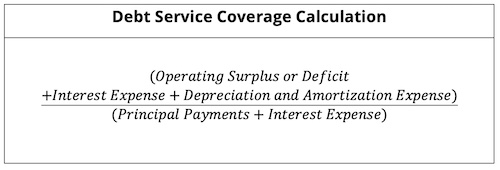
Debt Service Coverage Calculation text description: The image shows the formula for the Debt Service Coverage Calculation, which is the sum of Operating Surplus or Deficit plus Interest Expense plus Depreciation and Amortization Expense divided by the sum of Principal Payments plus Interest Expense.
Operating Cash Flow Margin Percentage
This calculation is consistent with Moody’s Investor Service methodology.1footnote
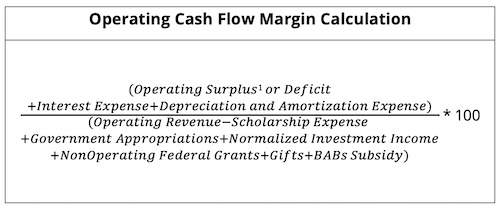
Operating Cash Flow Margin Calculation text description: The image shows the formula for the Operating Cash Flow Margin Percentage Calculation, which is two steps. First the sum of Operating Surplus or Deficit plus Interest Expense plus Depreciation and Amortization Expense is divided by the sum of Operating Revenue minus Scholarship Expense plus Government Appropriations plus Normalized Investment Income plus Nonoperating Federal Grants plus Gifts plus BABs Subsidy. The Operating Surplus is footnoted with Footnote 1. The results of step one are then multiplied by 100 to complete the calculation.
Operating Margin Percentage
This calculation is consistent with the University’s established methodology.
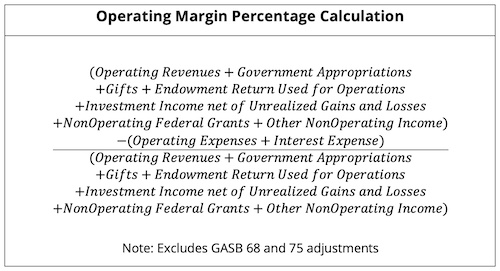
Operating Margin Percentage Calculation text description: The image shows the formula for the Operating Margin Percentage Calculation, which is three steps. Step 1 calculates the sum of Operating Revenues plus Government Appropriations plus Gifts plus Endowment Return Used for Operations plus Investment Income net of Unrealized Gains and Losses plus Nonoperating Federal Grants plus Other Nonoperating Income. Step 2 subtracts the sum of Operating Expenses plus Interest Expense from the results of Step 1. Step 3 then divides the results of Step 2 by the results of Step 1. There is also a note that this calculation excludes GASB 68 and GASB 75 adjustments.
Total Cash & Investments
This calculation is consistent with Moody’s Investor Service methodology.
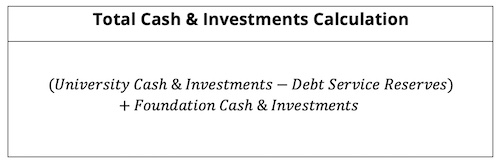
Total Cash & Investments Calculation text description: The image shows the formula for the Total Cash & Investments Calculation, which is the sum of University Cash & Investments minus Debt Service Reserves plus Foundation Cash & Investments.
Total Cash & Investments to Operating Expenses Ratio
This calculation is consistent with Moody’s Investor Service methodology.
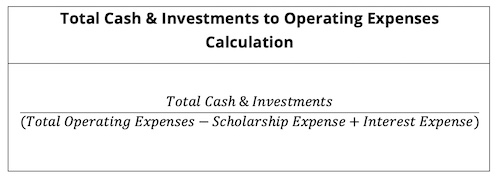
Total Cash & Investments to Operating Expenses Calculation text description: The image shows the formula for the Total Cash & Investments to Operating Expenses Calculation, which is Total Cash & Investments divided by the sum of Total Operating Expenses minus Scholarship Expense plus Interest Expense.
Total Cash & Investments to Total Adjusted Debt Ratio
This calculation is consistent with Moody’s Investor Service methodology.
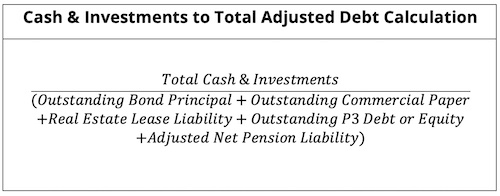
Total Cash & Investments to Total Adjusted Debt Ratio Calculation text description: The image shows the formula for the Total Cash & Investments to Total Adjusted Debt Ratio Calculation, which is Total Cash & Investments divided by the sum of Outstanding Bond Principal plus Outstanding Commercial Paper plus Real Estate Lease Liability plus Outstanding P3 Debt or Equity plus Adjusted Net Pension Liability.
IV. Exceptions
- Exceptions may be granted in accordance with the provisions of the Policy, which shall include, at a minimum, the following:
- The campus must submit a plan to the Board of Trustees through the Senior Vice President of Administration and Finance and Treasurer. The plan must be for a specific project, investment or deliberate response to an unanticipated disruption in planned funding or catastrophic event and include a defined duration, funding plan and other supporting documentation as needed.
- The Board of Trustees must vote to approve the exception for the specific project or investment.
- Board of Trustees approved exceptions shall be reported annually to the Committee on Administration and Finance when the University’s annual Financial Statements are approved.
V. Reporting
Beginning upon the release of the University’s FY27 Annual Financial Report, the Senior Vice President of Administration and Finance and Treasurer will provide the Board of Trustees a report reconciled to the Audited Financial Statements.
VI. Roles and Responsibilities
- The President, in consultation with the Senior Vice President of Administration and Finance and Treasurer and Chancellors, shall review, and as needed, update these Standards.
- The President may issue additional guidance specifying the accounting treatment for each reserve designation and its use.
- Chancellors shall implement and manage to the Policy and these Standards.
VII. Other Policies and Reports
The Policy and these Standards should be implemented in conjunction with and any proposed changes should be reviewed along with the following University policies and reports:
- University Debt Policy – T09-050
- Capital Planning, Land and Facility Use Policy – T93-122
- Quasi Endowment Policy – T07-018
- Report – 5-year Financial Forecast
- Report – University’s Annual Operating Budget
- Report – University’s Annual Audited Financial Statements
- back to citation1
The operating surplus for this metric uses the Moody’s calculation, which excludes endowment and investment income and uses a Normalized Investment Income (three year average of total cash & investments multiplied by 5%) value instead. The detailed calculation is as follows:
((Operating Revenue minus Scholarship Expense plus Government Appropriations plus Normalized Investment Income plus Nonoperating Federal Grants plus Gifts plus Build America Bonds (BABs) subsidy) minus (Operating Expenses minus Scholarship Expense plus Interest Expense plus Depreciation and Amortization Expense)) divided by (Operating Revenue minus Scholarship Expense plus Government Appropriations plus Normalized Investment Income plus Nonoperating Federal Grants plus Gifts plus BABs subsidy) and then multiplied by 100.